
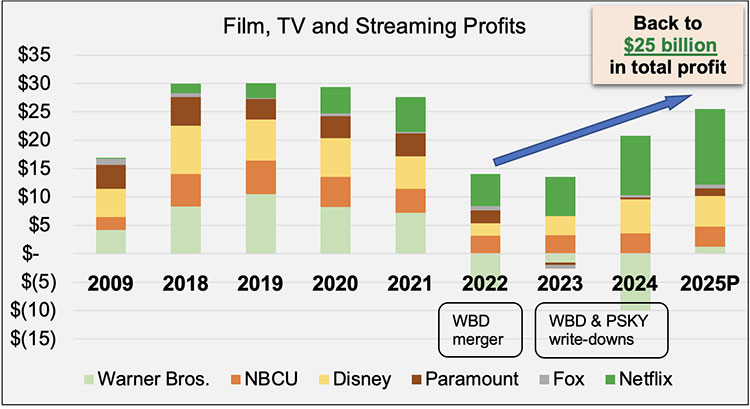
The industry’s transition to streaming as the dominant business has been challenging for writers, but the companies are watching their profits rebound after a short period of lower earnings.
Every three years during MBA negotiations, the companies will point to some part of their business that is not performing well to claim they couldn’t possibly meet writers’ needs. This cycle is no different. The truth is that the industry is producing billions in profits; the companies can afford to make a fair deal with writers.
Streaming as the Dominant Business
As streaming increasingly replaces traditional distribution, the more recent short-term volatility in entertainment profits is caused by this transition to a streaming-first model.
For decades, the studios earned profits from traditional distribution. In television, this meant a combination of advertising revenue and the fees cable companies pay to carry studios’ television networks; for films, it meant the domestic box office and the growing foreign box office, along with licensing and DVDs. With the rise of streamers in the 2010s, new money from streaming subscriber fees was added on top of revenues from traditional distribution—and our employers saw their profits soar to $30 billion a year in 2019.1
Disney+, Apple TV, HBO Max, and Peacock all launched in late 2019 and 2020, and Paramount+ rebranded and expanded in 2021. Joining Netflix, Amazon Prime, and Hulu, these streaming services ramped up series and film investment in 2020 and 2021, increasing their expenses and temporarily reducing their profits. The companies were also impacted by the global COVID-19 pandemic, which flattened theatrical attendance; the box office still hasn’t fully recovered.
As consumers started cancelling their cable subscriptions in higher numbers, the companies put more of their original programs onto their streaming services. Then in early 2022, Netflix reported subscriber losses for the first time and Wall Street demanded immediate profits from all the streaming services.
This led to a pullback in the number of series produced and the streamers introducing new strategies, like advertising tiers that Netflix had previously resisted. At the time, this was reported as “the great media market correction of 2022.”2
In the same period, Warner Bros. wasted billions on its merger with Discovery, and both Warner and Paramount took large write-downs—a common strategy for companies in transition—to pack additional losses into years of lower earnings and emerge as more profitable in the future.
 Source: Company financial reporting and WGAW estimates.
The WGA and SAG-AFTRA strikes of 2023 shortened the 2023-24 TV season and delayed major movie releases. After the strikes, the pullback on scripted entertainment continued in an increasingly streaming-dominated business. In 2024-2025, 60% of covered series were made for streaming, and nearly 40% of 2024 covered films had streaming releases. Now, entertainment profits are increasing again—projected to be $25 billion in 2025—as the companies build the profitable economics of streaming.
Profits on the Rise
The media companies’ recent strategies to increase profits in streaming have been successful. Of course, Netflix has been profitable for years, reaching more than $13 billion in profits in 2025. The legacy companies’ streaming services were all projected to be unprofitable for the first few years as the companies invested upfront in establishing and building their platforms. But, starting in 2023, Warner Bros. Discovery, began to report profits in its streaming business, followed by Disney in 2024 and Paramount in 2025.
Disney CEO Bob Iger summed it up in February 2026, when he announced a 72% year-over-year increase in streaming profits for the quarter:
“We’ve made huge progress turning the streaming business into a profitable business.”3
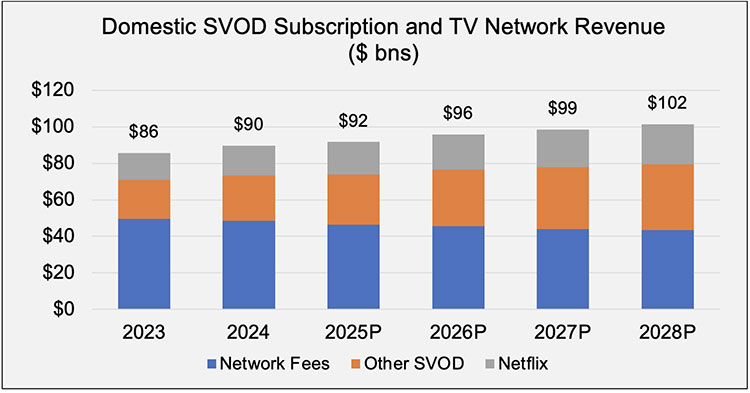
And now streaming profits are more than making up for declining TV affiliate fees, as fewer consumers subscribe to cable. Combined, domestic TV network revenue and streaming subscription revenues are projected to grow from $86 billion in 2023 to $102 billion in 2028.4
 Source: MoffettNathanson estimates.
And profits are projected to grow as the companies increasingly adopt familiar strategies of television, like advertising and bundles to keep subscribers. All the major streamers now offer an ad-supported subscription tier, adding a new and growing revenue stream. Netflix expects its ad revenue will double in 2026 and be a major driver for the company’s revenue growth. As Netflix CFO Spencer Neuman said earlier this year,
“So it's membership growth, it's pricing and it's a rough doubling of our ad revenue in 2026 to about $3 billion. So a bit more relative contribution from ads as we're scaling that business. And so we feel great about that, and we feel great about our operating profit growth and margin growth, too.”5
Wall Street firm MoffetNathanson estimates that Netflix now makes more money per each ad-supported user than it does from ad-free users.
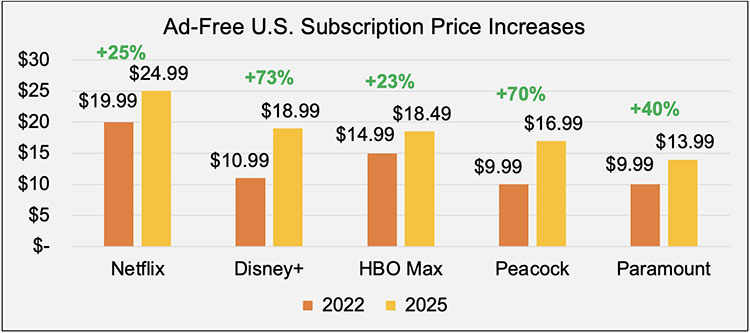
The media companies are also raising prices for their ad free tiers, facilitated by the introduction of their lower-cost ad-supported tiers. Netflix has raised prices in the U.S. by 25% since 2022 on its premium tier, and other services like Disney+ and Peacock have increased their ad-free tiers 70% or more. All of the global streamers have raised subscription prices internationally over the past few years as well, and they will continue to raise prices around the world going forward. Warner Bros. Discovery CEO David Zaslav put it simply in September 2025, about HBO Max:
“We think we’re way under price.”6
The companies have also been cracking down on password sharing and continuing to expand internationally, driven by U.S. programming. HBO Max is now available in 100 markets with more rollouts planned.7 Zaslav said in November 2025:
“We have found that all of our movies and scripted series… is a very compelling offering outside the U.S., and it is a driver of real growth, and it is quite differentiated.”8
 Source: MoffettNathanson estimates.
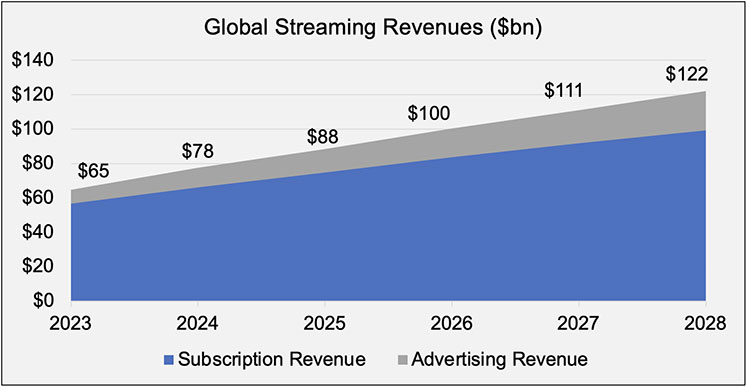
With all of this revenue expansion, including price increases, password crackdowns, global subscriber growth, and advertising, MoffettNathanson projects total global revenue across major US streamers could almost double from $65 billion in 2023 to over $122 billion in 2028.
Conclusion
The streamers continue to adopt the strategies that made the industry profitable for so long, leveraging the strength of the movies and series writers create. As streaming continues its upward ascent, the media companies can afford to negotiate a fair deal with writers.
1Company financials and WGAW analysis.
2Tyler Aquilina, “How Hollywood’s Horrible 2022 Impacted Content Spending,” Variety (Feb. 14, 2023).
3Bob Iger, The Walt Disney Company Chief Executive Officer, The Walt Disney Company Q1 2026 Earnings Call (Feb. 2, 2026).
4MoffettNathanson, “U.S. Media Can Streaming Stop the Bleeding?” (Oct. 27, 2025).
5Spencer Neumann, Netflix Chief Financial Officer, Netflix Q4 2025 Earnings Call (Jan. 20, 2026).
6David Zaslav, Warner Bros. Discovery President and Chief Executive Officer, Remarks at Goldman Sachs Communacopia + Technology Conference (Sep. 10, 2025).
7Warner Bros. Discovery Media Release, “HBO Max goes live in eight new countries including Germany and Italy – with highly anticipated series, films and sports events landing on the service this month” (Jan. 13, 2026).
8David Zaslav, Warner Bros. Discovery President and Chief Executive Officer, Warner Bros. Discovery Q3 2025 Earnings Call (Nov. 6, 2025).